Movement
How to Walk More Without Starting a Formal Workout Plan
A practical walking routine guide for adding more daily movement with simple cues, work breaks, low-friction routes, and no formal workout plan.
By A Healthy World Editorial Team · May 31, 2026 · 8 min read
Walking is one of the easiest forms of movement to picture and one of the hardest to turn into a repeatable routine. The problem is usually not whether walking is worthwhile. The problem is that people often treat it like a separate fitness project that needs extra time, perfect weather, the right mood, and a fully open schedule.
A more reliable approach is to stop thinking of walking as an event that lives outside normal life. It works better as part of the day you already have: a short errand loop, a lunch break, a school pickup buffer, a call taken outside, or a transition between work and home. When walking is built into real routines, it becomes easier to repeat without depending on motivation.
A calmer next step
Get one practical reset each week.
Short routines, useful checklists, and the next guide that fits what you are working on.
Start with walking that already fits your life
Many people aim too high too early. They imagine a daily hour-long walk, a perfect step goal, or a new identity as someone who exercises every morning. Those ideas can sound motivating, but they often fail because they ignore how crowded ordinary days already are.
A better starting point is to look for walking that already makes sense in your current routine. That could mean parking a little farther away, adding a lap before going back indoors, getting off public transport one stop earlier, or taking the long route to a nearby errand. These choices are not dramatic, but they are easier to keep because they do not require you to create a whole new block of life from scratch.
Use existing transitions as cues
The easiest walking habits are attached to something that already happens. Start of work, lunch, school runs, grocery trips, end-of-day decompression, and evening cleanup are all useful transition points. Instead of asking when you will find time to walk, ask which transition can hold five to fifteen extra minutes of movement.
This cue-based approach matters because it removes guesswork. You are not waiting to feel inspired. You are simply linking movement to a predictable part of the day.
Choose the smallest version that still counts
A habit does not need to be impressive to be useful. Ten minutes after lunch, one block before dinner, or a short walk while taking a phone call can all count. Smaller versions lower the chance that you will skip the habit on busy days.
Once the routine feels normal, you can extend it naturally. But the first job is not maximizing effort. The first job is making walking easy to begin again tomorrow.
- Pick a route you can do in regular clothes.
- Keep the first version short enough for weekdays.
- Decide in advance what counts as success.
Reduce friction before you rely on motivation
Walking happens more often when the practical barriers are smaller. If you have to hunt for socks, charge earbuds, check a fitness app, change into special clothes, and negotiate a complicated route, the habit starts to feel like a chore. The more steps between intention and action, the easier it is to postpone.
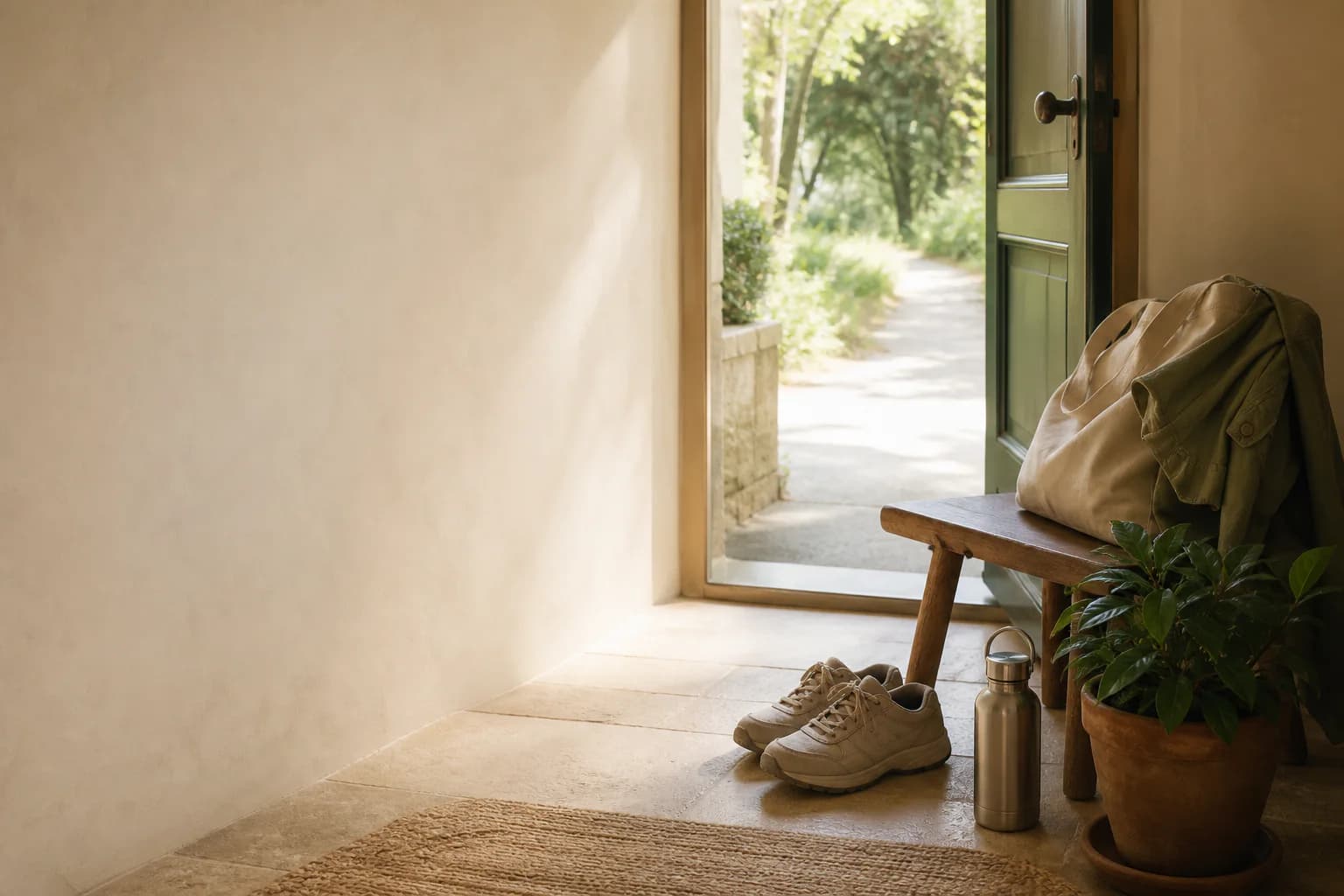
Most people do better with a low-maintenance setup. Comfortable shoes by the door, a weather-ready layer within reach, and a short default route are often enough. The goal is not to create the perfect walking system. The goal is to make it faster to leave the house or step outside than to talk yourself out of it.
Create a default route and a backup route
Decision fatigue matters. If you have to design a new walk every time, you add unnecessary friction. Choose one default route for normal days and one shorter backup route for rushed or low-energy days. This gives you an easy answer when the question comes up.
Your default route might be a neighborhood loop, a park path, or a few streets around work. Your backup route might be one block, five minutes outdoors, or two laps around a building. A backup version protects consistency when the day is not ideal.
Prepare for weather without making it dramatic
Weather is a common reason walking habits disappear. Instead of treating rain, wind, or heat as a full cancellation, prepare a lighter adjustment. Keep an umbrella handy, choose a shaded route, walk earlier, use an indoor corridor, or shorten the distance.
You do not need to force yourself through unsafe or miserable conditions. You just need an alternative that prevents one imperfect day from turning into a lost week.
Put this into practice
Build one realistic week with small actions, clear cues, and fallback versions for busy days.
Build walking into moments that already have a purpose
Walking is easiest to keep when it does more than one job. A short walk can help you reset after work, make a phone call feel less sedentary, add movement to an errand, or create a buffer before going back into the house. Purpose makes the habit feel useful instead of optional.
This is especially helpful for people who do not enjoy formal exercise culture. You do not need to perform healthiness. You need movement that fits how you actually live.
Turn routine tasks into walking opportunities
Some of the best walking habits happen around things you were already going to do. Walk to pick up one or two groceries. Take the long route when dropping something off. Use a walking meeting when you do not need a screen. Add a lap before heading home from work or after dinner cleanup.
These choices work because they are tied to real tasks, not abstract goals. They also tend to feel more sustainable than trying to carve out perfect workout windows every day.
- Take one work call while walking.
- Add a short loop after lunch three days this week.
- Walk one local errand instead of driving when practical.
Use walking as a transition, not a test
Walking can be a simple way to change mental gears. A brief walk before work can help you arrive more intentionally. A lunchtime walk can separate the first half of the day from the second. An evening walk can mark the shift out of work mode.
When walking becomes a transition cue, it stops being a pass-fail challenge. It becomes part of the structure of the day.
Track consistency in a simple way
Tracking can help, but it should support the behavior instead of stealing attention from it. If step targets, apps, and streaks motivate you, they can be useful. If they make the habit feel performative or easy to abandon, choose something simpler.
A basic checklist often works well: did you take the lunch walk, the errand walk, or the evening reset walk? This keeps the focus on whether the routine happened, not whether the number was impressive.
Review patterns instead of chasing perfect numbers
At the end of the week, look for patterns. Which cue worked best? Which route felt easiest? What kept getting skipped? That information is more useful than trying to win every day.
If the same walk keeps failing, shrink it, move it, or attach it to a more reliable cue. The best walking habit is the one you can keep using when life is normal, not the one that looks best on paper.
Try a one-week walking reset
If you want to make walking more automatic, test one simple version for the next seven days. Pick one cue, one route, and one backup option. Keep your shoes visible, decide what counts, and let the first week be about learning rather than proving something.
This article is educational only and is not medical advice. If walking causes pain or you have a condition that affects movement, it is wise to speak with a qualified professional before changing your routine.
- Choose one anchor: lunch, errand, commute, or evening transition.
- Set a default route and a five-minute backup route.
- Use the habit planner to map the next seven days before the week gets busy.