Movement
How to Build an After-Dinner Walking Routine Without Making Evenings Feel Longer
A practical after-dinner walking routine with easy cues, short routes, and low-light backups so evening movement fits real life.
By A Healthy World Editorial Team · June 30, 2026 · 8 min read
An after-dinner walk sounds simple until dinner runs late, the kitchen still needs attention, the couch starts looking persuasive, or the evening gets darker than expected. The version that lasts is usually not a long scenic walk. It is a short, repeatable loop that fits the way your evenings already work and still feels manageable on ordinary weeknights.
This article is educational only and is not medical advice. CDC guidance and the Physical Activity Guidelines for Americans note that adults benefit from moving more and sitting less, and that some physical activity is better than none. NHTSA pedestrian safety guidance also recommends using sidewalks when available and choosing crosswalks or well-lit places to cross when walking near traffic, especially in lower light. If walking causes pain, dizziness, or you have a condition that affects activity, speak with a qualified professional. The goal here is practical: make an after-dinner walk easy enough to repeat without turning the evening into another project.
A calmer next step
Get one practical reset each week.
Short routines, useful checklists, and the next guide that fits what you are working on.
Start with the smallest walk that still feels useful
Many evening walking plans fail because they begin with an ambitious picture: a long neighborhood route, a perfect sunset routine, or a promise to make every night highly productive. That can sound appealing, but it creates too much resistance on regular days. A more reliable starting point is a short loop you can still imagine doing after a normal dinner, normal cleanup, and normal energy drop.
For some households that means 10 minutes outside. For others it means one block, one lap around a nearby path, or a walk to a small errand destination and back. The point is not to prove effort. The point is to create an evening cue that feels realistic enough to survive weeknights that are only moderately organized.
- Choose a route short enough for ordinary evenings, not unusually calm ones.
- Let the first version feel modest instead of impressive.
- Decide in advance what counts as a successful walk.
Why shorter works better at first
A shorter walk is easier to start, easier to finish, and easier to repeat tomorrow. Once the cue feels normal, you can always extend the route occasionally. The first win is consistency, not distance.
Attach the walk to the end of dinner, not to a perfect clock time
A fixed evening time often breaks as soon as dinner shifts by 20 minutes. A better cue is the end of the dinner process itself. That might be after the plates are cleared, after leftovers are packed, after the dishwasher starts, or after one quick counter reset. Linking the walk to a step you already notice makes it more stable than promising to go at exactly 7:00 every night.
This matters even more in shared homes. If different people finish eating at different speeds or cleanup happens in stages, the cue should still be obvious. You are looking for the moment that means dinner is functionally over, not for a perfect lifestyle schedule.
- Pick one dinner-finish cue that already happens most nights.
- Keep the cue concrete enough that you do not have to debate it.
- Use the same cue for the short version and the full version.
Examples of useful evening cues
Good cues are visible and specific. 'After dinner' is vague. 'After I put leftovers away' or 'after I wipe the table' is much easier to repeat because you can see when it has happened.
- After the dishes are in the sink or dishwasher.
- After leftovers are labeled and put away.
- After one two-minute kitchen reset.
- After the dog is fed or the lunch bag is prepped for tomorrow.
Put this into practice
Build one realistic week with small actions, clear cues, and fallback versions for busy days.
Choose a route that still works in low light and normal weather
After-dinner walking is often less about motivation than about route design. If the usual route feels awkward once it is dark, too exposed to traffic, or annoying in light rain, the habit will quietly disappear. The most useful route is usually the one you feel comfortable repeating in the actual conditions you have most evenings.
That may mean a shorter well-lit loop, a sidewalk-heavy route, a route near a park entrance rather than through it, or a route that stays close to home. If you regularly walk near traffic in lower light, choose the version with the clearest crossings and the fewest complicated decisions.
- Use sidewalks when they are available.
- Choose crossings and route segments that are easy to read at night.
- Prefer the route you can repeat safely and comfortably over the route that looks best on paper.
Build one indoor or bad-weather backup
A backup keeps one rainy, windy, or overly dark evening from turning into a lost week. That backup might be a shorter covered route, a hallway loop, a few indoor laps while a podcast plays, or a quick walk earlier in the evening when the weather window is better. The goal is not to force the outdoor version every time. It is to keep the cue alive.
Lower the friction between cleanup and getting out the door
The hardest part of an after-dinner walk is often not the walk. It is the gap between finishing dinner and starting movement. If that gap includes searching for shoes, deciding whether the kitchen is clean enough, checking the weather from scratch, or negotiating a complicated family plan, the walk starts to feel optional.
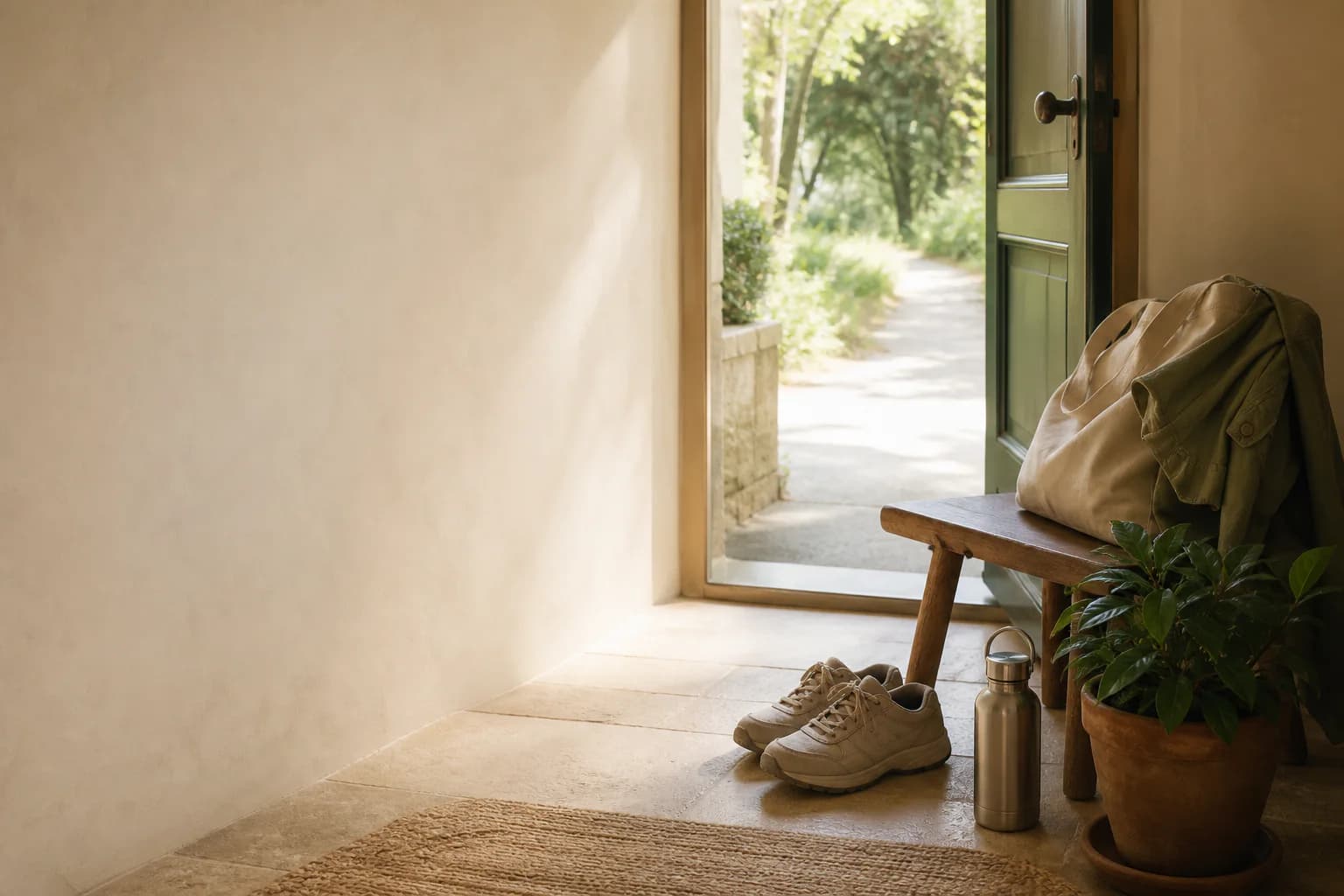
Small setup choices help. Keep shoes near the door, leave a light layer where you can grab it, decide whether the walk happens before or after full cleanup, and make the route obvious. If you live with other people, agree on the minimum version so the decision does not have to be reopened every night.
- Keep shoes and one evening layer easy to reach.
- Decide what minimum cleanup happens before the walk.
- Reduce the number of decisions between dinner and the first step outside.
Use a split-cleanup approach if evenings feel crowded
Some households do better with a fast reset before walking and the rest after. For example, leftovers away, dishes soaking, counters cleared, then walk. That can feel easier than waiting until every kitchen task is finished and losing the evening momentum completely.
Create a normal version and a low-energy version
An after-dinner walk habit lasts longer when it has two versions. The normal version might be 10 to 20 minutes on your main route. The low-energy version might be five minutes, one block, or one lap before coming home again. Without that smaller option, tired nights tend to erase the cue entirely.
The smaller version is not a loophole. It is what allows the routine to survive busy dinners, warm weather, family logistics, and evenings when energy drops faster than expected. If the cue happens and some walking follows, the habit is still intact.
- Choose one standard route and one shorter fallback route.
- Let the low-energy version count on purpose.
- Use the same cue even when the walk is shorter.
What a fallback can look like
A fallback might be walking to the corner and back, doing one loop around the block, or walking while finishing one easy audio call. It should be small enough that you can still do it on the kind of night that would normally cancel the habit.
Give the walk one evening job
After-dinner walking gets easier when it does more than one thing for the evening. It can be a transition out of work mode, a short family check-in, a dog walk with a clearer purpose, a phone-free reset before screens take over, or a way to separate dinner from the rest of the night. Purpose helps the walk feel useful instead of decorative.
That does not mean it has to become a productivity trick. It simply means naming why this walk belongs in your evening. When the walk has a job, it is easier to protect than a vague idea that you should probably be more active.
- Use the walk as a transition between dinner and the rest of the evening.
- Pair it with one purpose that already matters in your home.
- Keep the purpose simple enough that it supports the walk instead of complicating it.
Examples of useful evening roles
The walk might be your quiet reset before chores, your conversation loop with a partner, your dog-walking anchor, or your boundary between dinner and sitting down for the night. The best role is the one that matches the evening you already have.
Common mistakes that make after-dinner walking harder than it needs to be
One common mistake is choosing a route that only feels appealing in ideal weather or full daylight. Another is waiting until the entire kitchen is spotless before deciding whether to go. A third is making the walk long enough that it competes with the rest of the evening instead of fitting inside it.
Another trap is treating every night the same. Some evenings need the normal route. Some need the shorter version. Some need the indoor backup. The routine gets stronger when it is flexible enough to survive real evenings, not when it depends on perfect discipline.
- Do not start with a route that feels too long after a normal dinner.
- Do not rely on an exact clock time if dinner timing changes often.
- Do not choose a low-light route that feels awkward or hard to cross safely.
- Do not skip the fallback version for tired or rushed nights.
Try a five-night after-dinner walking reset
If you want to make evening walking more automatic, test it for five nights instead of trying to redesign the whole week. Night one is for choosing the cue and route. Night two is for repeating the same route. Night three is for trying the shorter fallback on purpose. Night four is for using the walk for one evening job, such as a reset or family check-in. Night five is for reviewing what made the habit easiest to start.
That short reset is enough to learn whether the route is too long, whether the cue needs to move, and whether the cleanup sequence is realistic. Keep the version that fits real evenings. If the routine helps you move a little more without making the night feel crowded, it is doing its job.
- Night 1: choose the dinner-finish cue and default route.
- Night 2: repeat the same walk without changing anything.
- Night 3: use the short fallback version on purpose.
- Night 4: give the walk one evening job.
- Night 5: review what felt easiest to repeat.