Movement
How to Build a Lunchtime Walking Routine Without Eating at Your Desk
A practical lunchtime walking routine with easy routes, lunch timing options, and fallback versions that fit a real workday.
By A Healthy World Editorial Team · July 9, 2026 · 8 min read
A lunch walk sounds like a simple healthy habit until it collides with meetings, commute timing, food prep, office culture, and the fear that if you leave your desk you will lose the whole break. The version that lasts is usually much less ambitious. It uses a short route, a clear plan for when you will eat, and a setup that makes it easy to step out and easy to come back.
This article is educational only and is not medical advice. CDC guidance says adults should get at least 150 minutes of moderate-intensity physical activity each week, and both the CDC and the Physical Activity Guidelines for Americans say adults should move more and sit less and that some activity is better than none. NHTSA pedestrian safety guidance says to use sidewalks when available and cross at crosswalks or intersections. If walking causes pain, dizziness, or you have a condition that affects activity, speak with a qualified professional. The goal here is practical: make a lunchtime walking routine easy enough to repeat without sacrificing your lunch or turning the workday into a logistics problem.
A calmer next step
Get one practical reset each week.
Short routines, useful checklists, and the next guide that fits what you are working on.
Start with the smallest lunch walk that still feels worth doing
Many lunch-walk plans fail because they begin with a 30-minute fantasy. The imagined version includes a calm lunch break, a scenic route, perfect weather, and enough spare time to walk, eat, and reset without any pressure. That is not how most workdays behave. A better starting point is a short route you can still picture on a day with meetings, messages, and a normal amount of friction.
For some people that means 10 minutes outside. For others it means one block, one office-park loop, one lap around the building, or a short route to a bench and back. The first goal is not maximizing distance. It is proving that a lunch walk can fit the middle of the day without making lunch feel rushed or work feel harder afterward.
- Choose a route short enough for ordinary workdays, not unusually quiet ones.
- Let the first version feel modest instead of impressive.
- Decide ahead of time what counts as a successful lunch walk.
Why shorter works better at first
A shorter walk lowers the barrier to starting. It is easier to fit between meetings, easier to recover if the day shifts, and easier to repeat tomorrow. Once the cue feels normal, you can always stretch the route sometimes. Consistency matters more than making lunch look athletic.
Decide when you will eat so the walk does not compete with lunch
One reason lunch walking disappears is that people never settle the food question. They assume the walk means eating at the keyboard later, skipping lunch entirely, or trying to inhale food in the last three minutes of the break. A stronger system decides that part in advance. You might eat before the walk, eat after the walk, or split lunch into two simple pieces when the schedule is awkward.
The exact pattern matters less than removing uncertainty. If you already know what lunch looks like on a walking day, the habit becomes much easier to trust. You are not trying to squeeze movement into a gap you have not designed. You are giving the midday break a simple shape that includes both food and movement.
- Choose one default: eat before walking, eat after walking, or split lunch into two short parts.
- Match the plan to your real break length, not the version you wish you had.
- Keep the food decision simple enough that you do not end up back at your desk by default.
Examples of workable lunch patterns
If lunch is packed and ready, many people find it easiest to eat first and walk second. If your morning feels crowded, walking first and eating right after can work well. If your workplace timing is unpredictable, a split version can help: one quick food item before the walk and the rest after.
- Eat first, then walk when the meal is already prepared.
- Walk first, then eat if the walk helps you reset before the afternoon.
- Split lunch when one long uninterrupted break is hard to protect.
Put this into practice
Build one realistic week with small actions, clear cues, and fallback versions for busy days.
Attach the walk to a visible midday cue, not to a perfect clock time
A lunch walk works better when it belongs to a cue you can actually notice. That might be after your calendar clears, after you heat your lunch, after you close one work block, or after you finish one morning meeting cluster. Linking the walk to a visible transition is more reliable than promising that you will walk at exactly 12:00 every day.
This matters because lunch rarely lands at the same minute in real life. Some days start early. Some run long. Some need a shorter break and a faster return. The stronger habit is the one that survives those shifts because it is attached to a repeatable moment, not a fantasy schedule.
- Choose one midday cue that happens most workdays.
- Use the same cue for the short version and the normal version.
- If the walk keeps disappearing, make the cue more specific.
Examples of useful lunch cues
Good cues are concrete. 'Around lunchtime' is vague. 'After I put lunch in the fridge at 11:30' or 'after my morning meeting block ends' is much easier to repeat because you can tell exactly when it has happened.
- After finishing the morning's main work block.
- After heating or unpacking lunch.
- After the last meeting before the afternoon starts.
- After sending one clear handoff or status note.
Choose one default route with an easy turnaround and return
Lunchtime walking gets much easier when the route is already settled. If you have to decide where to go, how far to walk, whether you have time, and how to get back before the next task, the habit starts feeling optional. One default route solves most of that. It gives you a clear path, a clear turnaround point, and a predictable return to your desk or workspace.
The best route is usually boring. It might be a sidewalk loop around the block, a business-park lap, a short residential circuit near home, or an indoor route when weather or workplace layout makes outside awkward. NHTSA guidance says to use sidewalks when available and cross at crosswalks or intersections, which is another reason to choose the straightforward route over the scenic but inconvenient one.
- Pick one default route that is easy to finish on time.
- Choose the route with simple sidewalks and crossings when possible.
- Know roughly how long the route takes before relying on it.
Keep the route easy to re-enter from
A lunch walk should not create a messy restart. Routes that end close to your building, kitchen, or home setup are easier to repeat because you are not adding a second transition after the walk. The cleaner the return, the less the habit feels like it steals from the rest of the day.
Reduce the friction between your desk and the door
The hardest part of a lunch walk is often not the walking. It is the setup gap. If you need to search for shoes, find your badge, pack your lunch after the break has already started, decide whether the weather is manageable, and guess what task to return to, the walk becomes surprisingly expensive. Lower-friction routines win here.
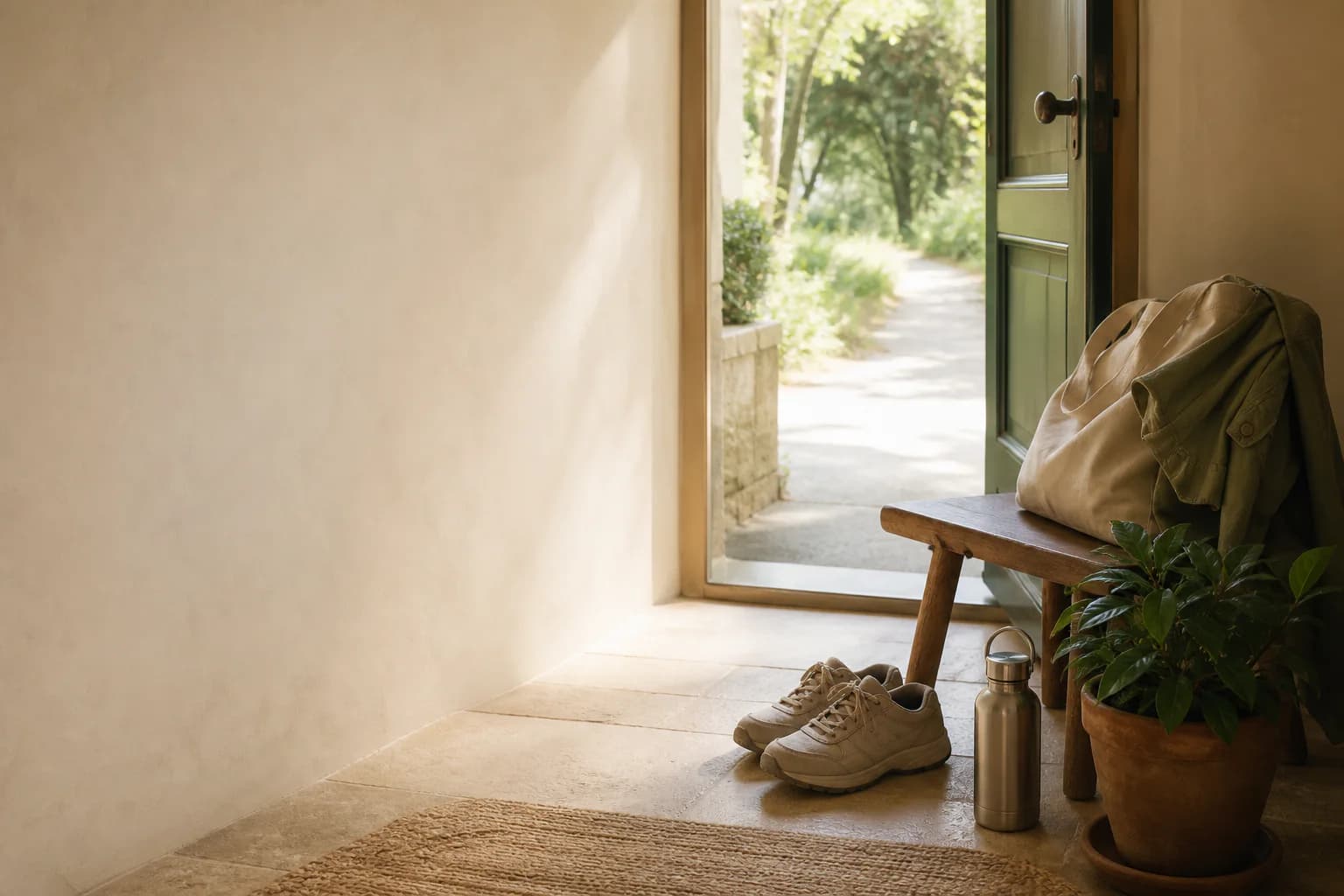
Keep the few things you actually need ready before lunch arrives. That might mean comfortable shoes near the door, a light layer on the chair, a badge in the same pocket, or lunch packed the night before. The goal is not building a high-performance system. It is making the first step outside simpler than staying stuck in place.
- Keep shoes, badge, keys, or one weather layer easy to grab.
- Prepare lunch early enough that the walk does not consume the food setup time.
- Leave one obvious next task for your return.
Use a one-minute return ritual
A short restart sequence can keep the walk from bleeding into drift. Refill water, reopen the task you chose before leaving, and spend one minute re-entering work instead of opening three unrelated tabs. That keeps the break useful instead of messy.
Give the walk one midday job besides movement
A lunch walk lasts longer when it does more than check a healthy-habit box. It might be your break from screens, your reset between morning and afternoon work, your daylight cue, your boundary against eating every lunch at the keyboard, or your way to avoid feeling like the whole day happened in one chair. When the walk has a clear role, it feels more useful and easier to protect.
This does not mean turning the walk into a productivity hack. It just means naming why it belongs in your day. Useful habits usually survive because they solve a real problem, not because they look good on paper.
- Use the walk as a screen break, transition, or midday reset.
- Pair it with one real need that already matters in your workday.
- Keep the role simple enough that it supports the walk instead of complicating it.
Examples of useful lunch-walk roles
Your lunch walk might be the line between morning tasks and afternoon focus, the reason you actually leave the building once a day, the cue that keeps lunch off the keyboard, or the small outside break that makes the second half of the day feel less stale.
Create a normal version, a rushed-day version, and a bad-weather backup
A lunchtime walking habit lasts longer when it has more than one size. The normal version might be 10 to 20 minutes on your usual route. The rushed-day version might be five minutes or one short loop. The bad-weather backup might be an indoor lap, a covered route, or moving the walk to another useful transition later in the day.
This matters because lunch breaks are vulnerable to real life. Meetings run over. Weather shifts. A coworker needs something. A delivery arrives. If the habit only works on ideal days, it will disappear quickly. If the cue can survive in a smaller form, the routine stays alive.
- Choose one standard route and one shorter fallback route.
- Decide what the indoor or weather backup is before you need it.
- Let the smaller version count on purpose.
When to move the walk instead of forcing it
Some days the lunch window is simply not workable. That does not mean the habit failed. It may mean using the same short route after the next meeting block or attaching the backup version to the end of the workday. The cue matters more than the exact minute.
Common mistakes that make lunchtime walking harder than it needs to be
One common mistake is assuming the walk only counts if it takes the full lunch break. Another is never deciding when lunch will actually be eaten, which quietly pushes the meal back to the desk. A third is choosing a route that looks good in theory but has awkward crossings, unclear timing, or too much setup for a real workday.
Another trap is treating every lunch break the same. Some days fit the normal route. Some only fit the short version. Some need the indoor backup. The routine gets stronger when it is flexible enough to survive real schedules instead of depending on a perfectly protected noon hour.
- Do not start with a route that only fits very open days.
- Do not leave the food plan undecided until the break starts.
- Do not choose a route with awkward crossings or a messy return.
- Do not treat the fallback version like failure.
Try a five-day lunchtime walking reset
If you want to make lunch walking more automatic, test it for five workdays instead of trying to redesign the whole month. Day one is for choosing the cue, the route, and your food plan. Day two is for repeating the same short walk. Day three is for improving the desk-to-door setup. Day four is for using the rushed-day or indoor backup on purpose. Day five is for reviewing what made the habit easiest to repeat.
That short reset is enough to learn whether the route is too long, whether the lunch plan is clumsy, and whether the real friction is timing, shoes, weather, or workplace culture. Keep the version that helps you move a little more without turning lunch into another task to manage.
- Day 1: choose the cue, route, and lunch plan.
- Day 2: repeat the same short walk.
- Day 3: improve the desk-to-door setup.
- Day 4: use the rushed-day or indoor backup on purpose.
- Day 5: review what felt easiest to repeat.