Movement
How to Start a Morning Walking Routine Without Waking Up an Hour Earlier
A practical morning walking routine with short routes, simple cues, and night-before prep that fits real mornings without a 5 a.m. overhaul.
By A Healthy World Editorial Team · July 7, 2026 · 8 min read
A morning walk sounds like a clean healthy habit until it starts asking for a much earlier alarm, a full outfit change, a perfect weather window, and a level of morning energy you do not actually have. The version that lasts is usually smaller. It fits inside the morning you already live, uses a short route, and asks for fewer decisions before you even get out the door.
This article is educational only and is not medical advice. CDC guidance says adults need at least 150 minutes of moderate-intensity physical activity each week, the Physical Activity Guidelines for Americans note that adults should move more and sit less and that some physical activity is better than none, and NHTSA pedestrian safety guidance recommends using sidewalks when available, crossing at crosswalks or intersections, and being more visible in low light. If walking causes pain, dizziness, or you have a condition that affects activity, speak with a qualified professional. The goal here is practical: make a morning walking routine easy enough to repeat without turning it into a pre-dawn fitness project.
A calmer next step
Get one practical reset each week.
Short routines, useful checklists, and the next guide that fits what you are working on.
Start with the shortest walk that still feels worth doing
Many morning walking plans fail because they start with an ambitious image: a long sunrise route, a podcast episode before breakfast, or a promise to become the kind of person who is fully active before the rest of the house wakes up. That can sound motivating, but it creates too much friction for ordinary mornings. A better start is a short walk you can still imagine doing after a normal wake-up, normal bathroom stop, and normal level of alertness.
For some people that means five to ten minutes outside. For others it means one block, one small neighborhood loop, or walking to the corner and back before breakfast. The first goal is not maximizing distance. It is proving that walking can fit the first part of the day without making the morning feel rushed or fragile.
- Choose a walk short enough for weekdays, not only unusually calm mornings.
- Let the first version feel modest instead of impressive.
- Decide ahead of time what counts as a successful morning walk.
Why a smaller start works better
A shorter walk lowers resistance at the exact moment when resistance is usually highest. It is easier to begin, easier to finish, and easier to repeat tomorrow. Once the cue feels normal, you can always extend the route sometimes. Consistency comes before ambition.
Attach the walk to a real morning cue, not to a fantasy schedule
A morning walk works better when it belongs to a cue you already notice instead of to an exact clock time that keeps changing. A useful cue might be after you use the bathroom, after coffee starts brewing, after you get dressed, after you pack lunch, or after the first part of the school or workday setup is finished. Linking the walk to a stable step makes it much easier to repeat than promising that you will go out at exactly 6:00 every day.
This matters because mornings are rarely identical. Wake-up time shifts, sleep is uneven, and responsibilities change. The stronger routine is the one that survives a later start because the cue is still visible. You are looking for the first reliable moment when walking still fits without creating a cascade of lateness.
- Choose one morning step that happens most days before screens or commute pressure take over.
- Use the same cue for the short version and the normal version.
- If the walk keeps disappearing, move it earlier or make the cue more specific.
Examples of useful cues
Good cues are concrete. 'Before work' is vague. 'After I put on my shoes' or 'after coffee starts' is easier to repeat because you can clearly tell when it has happened.
- After getting dressed.
- After starting coffee or tea.
- After packing your bag or lunch.
- After opening the curtains and stepping into the day.
Put this into practice
Build one realistic week with small actions, clear cues, and fallback versions for busy days.
Do the night-before setup so the morning has fewer decisions
The hardest part of a morning walk is often the setup gap. If you have to hunt for socks, decide what to wear, check the weather from scratch, find your keys, and figure out whether the route still makes sense, the walk starts to feel negotiable. Small night-before preparation removes that negotiation.
Set out the clothes you plan to wear, or at least the shoes and outer layer. Put your keys, headphones if you use them, and anything else you genuinely need in one spot. Decide whether you will walk before breakfast, after a small snack, or right after you get dressed. The more you can answer at night, the less the morning has to rely on motivation.
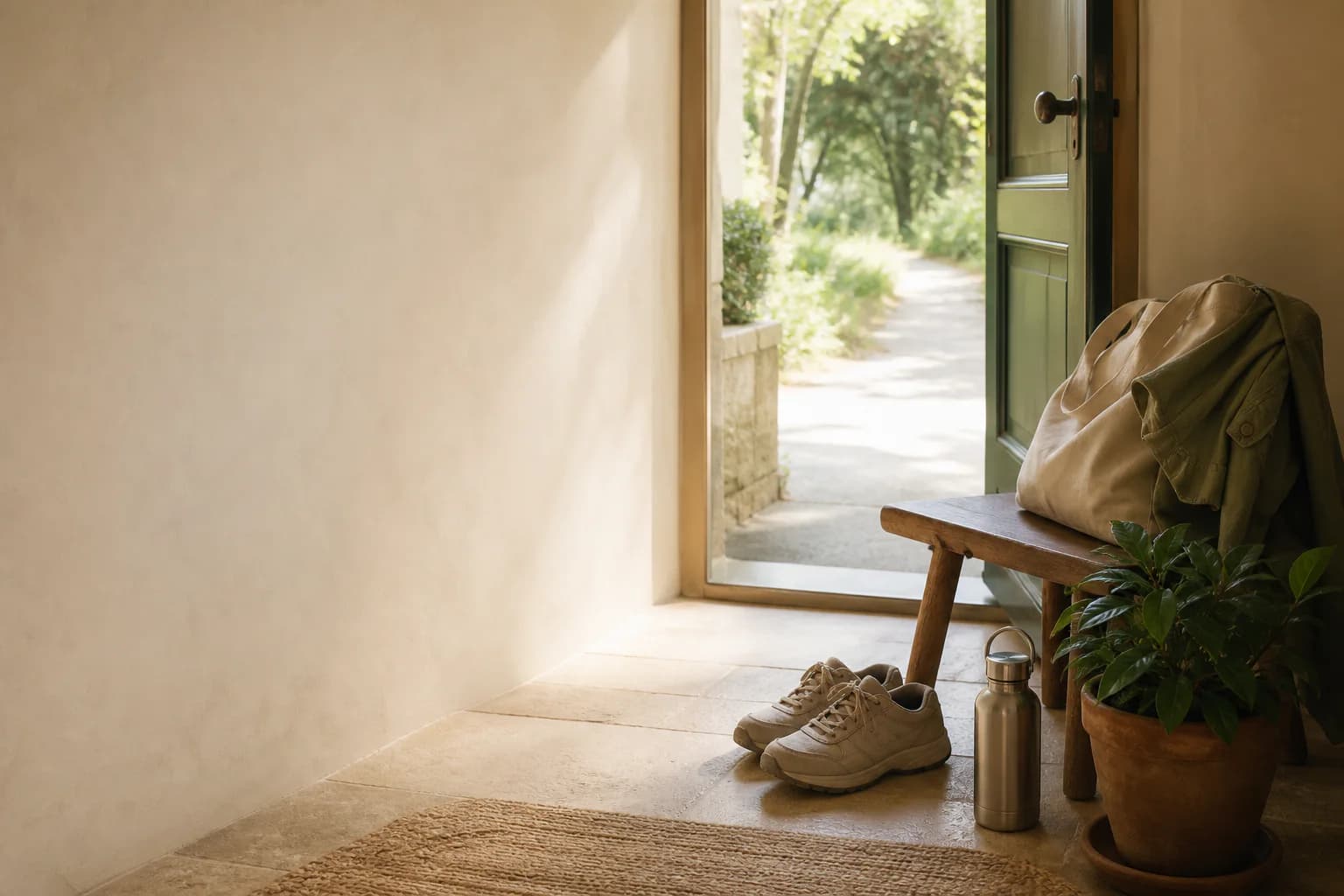
- Keep walking shoes visible near the door or your usual getting-ready area.
- Set out one weather-appropriate layer the night before.
- Decide the route and the length before you go to bed.
Do not overbuild the setup
A morning walk should not require a full athletic routine unless that genuinely suits your life. If regular clothes and comfortable shoes work for your short route, that is often a stronger system than one that needs technical gear every day.
Choose one route that works on normal mornings
A default route removes one more daily decision. If you have to invent the walk each morning, judge how much time you have, and reconsider every intersection, the habit becomes mentally expensive. One reliable route is usually enough at the start. It might be one neighborhood loop, one stretch of sidewalk and back, one circuit around the block, or one simple path near home.
Pick the route that fits your real morning conditions, not the prettiest route in theory. If you leave the house before full daylight, choose the clearer and more familiar option. If the morning is often crowded, choose the version with the fewest complicated crossings and the most predictable timing.
- Use a route you can finish without checking your phone for time every minute.
- Prefer the route that is easy to repeat over the route that feels more ambitious.
- Know roughly how long the route takes before depending on it.
Build one backup for rushed or bad-weather mornings
A backup keeps one rough morning from breaking the routine. That backup might be a five-minute version outside, a shorter loop, a covered route, or a brief indoor walk if conditions are poor. The point is not to force the full version every day. The point is to keep the cue alive.
Give the walk one clear morning job
Morning walking gets easier when it does more than check a health box. It might be the transition from sleep to work mode, a calmer start before the inbox, a phone-free first action, a dog-walking anchor, or a way to wake up before sitting down all day. Naming the job helps you protect the habit because it feels useful, not decorative.
That does not mean the walk needs to solve everything. It only means it belongs somewhere in the structure of the morning. A walk that has a job is easier to repeat than one that exists only because you think you probably should be more active.
- Use the walk as a transition into the rest of the day.
- Pair it with one real need such as waking up, getting daylight, or starting without screens.
- Keep the job simple enough that it supports the walk instead of complicating it.
Create a normal version and a rushed-day version
A morning walking habit lasts longer when it has two built-in sizes. The normal version might be 10 to 20 minutes on your default route. The rushed-day version might be five minutes, one block, or one quick outside loop before you continue the morning. Without that smaller option, one overslept day can turn into three skipped days in a row.
The shorter version is not a loophole. It is the practical design feature that keeps the habit connected to the cue. If you still step outside and walk a little on a busy morning, the routine is still alive.
- Choose one default route and one shorter fallback route.
- Let the rushed-day version count on purpose.
- Use the same cue even when the walk is shorter.
A fallback should be almost too easy
If the rushed-day version still feels hard when you are tired and running late, it is too large. Make it smaller until it is realistic on the exact kind of morning that usually cancels the habit.
Keep low-light and traffic safety simple
If your morning walk happens before full daylight or near traffic, simplify the safety choices in advance. NHTSA recommends using sidewalks when they are available, crossing at crosswalks or intersections, staying alert, and being more visible in lower light. That is another reason to choose a straightforward route instead of improvising in the dark.
You do not need a complicated safety checklist. You need a route that is easy to read, clothing or layers that help you be seen when needed, and a walking setup that does not depend on staring at your phone while moving. The calmer the route design, the easier it is to keep the habit practical.
- Use sidewalks when available and choose clear crossing points.
- If it is dark, wear visible layers and stay alert near traffic.
- Skip the route that feels awkward, poorly lit, or hard to repeat safely.
Common mistakes that make morning walking harder than it needs to be
One common mistake is assuming the walk only counts if it requires a much earlier alarm. Another is trying to start with a route long enough to compete with breakfast, commute time, or getting everyone else out the door. A third is treating every morning the same when the routine clearly needs both a normal version and a fallback.
Another trap is ignoring the setup. If shoes are hidden, the weather layer is missing, and the route changes every day, the habit depends on too many fresh decisions before breakfast. Morning walking gets easier when it becomes boring infrastructure instead of a daily performance.
- Do not start with a route that only fits ideal mornings.
- Do not depend on an exact clock time if your wake-up time shifts.
- Do not skip the night-before setup and expect motivation to handle the rest.
- Do not treat the fallback version like failure.
Try a five-morning walking reset
If you want to make the habit more automatic, test a five-morning reset instead of chasing a perfect month. Morning one is for choosing the cue, the route, and the fallback. Morning two is for repeating the same short route. Morning three is for improving the night-before setup. Morning four is for using the rushed-day version on purpose. Morning five is for reviewing what made the walk easiest to start.
That is enough to learn whether the route is too long, whether the cue happens too late, and whether the real problem is clothing, timing, or decision fatigue. Keep the version that fits real mornings. If the walk helps you move a little more without making the rest of the day harder, it is doing its job.
- Morning 1: choose the cue, route, and fallback.
- Morning 2: repeat the same short walk.
- Morning 3: improve the night-before setup.
- Morning 4: use the rushed-day version on purpose.
- Morning 5: review what felt easiest to repeat.