Movement
How to Move More on Work-From-Home Days Without Blocking Off Workout Time
A practical work-from-home movement routine with short cues, home routes, and standing or walking backups that fit between real tasks.
By A Healthy World Editorial Team · August 29, 2026 · 9 min read
Working from home can remove the commute, but it can also quietly remove many of the small movements that used to break up the day. The walk to the car, the trip from the station, the stairs to an office floor, the short errand at lunch, and even the walk to a coworker's desk can disappear. What often replaces them is a very efficient path from bed to coffee to laptop, followed by long stretches of sitting that feel hard to interrupt once the workday is moving.
This article is educational only and is not medical advice. CDC guidance and the Physical Activity Guidelines for Americans say adults should move more and sit less, that some physical activity is better than none, and that activity can be broken into smaller chunks across the week. NIOSH guidance for working from home says periodic rest breaks and changes in posture are beneficial and suggests taking breaks from screens and sitting to stretch, walk, climb stairs, or rehydrate. If walking or standing causes pain, dizziness, numbness, or you have a condition that affects activity or balance, speak with a qualified professional. The goal here is practical: build a work-from-home movement routine that fits real calls, deadlines, and household distractions without requiring a separate workout block first.
A calmer next step
Get one practical reset each week.
Short routines, useful checklists, and the next guide that fits what you are working on.
Start with the transitions that already exist in a home workday
Most work-from-home movement plans fail because they start as a second schedule. People imagine a dedicated morning workout, a lunch walk, an afternoon stretch break, and an evening session, all before they have identified where movement could fit naturally. A better start is noticing the transitions that are already built into remote work: logging on, ending a meeting block, reheating lunch, waiting for coffee, finishing one task before opening the next, or shutting the laptop at the end of the day.
Those moments matter because they already have edges. You do not need to invent a perfect time to move. You only need to give one existing transition a different default. That is much easier to repeat than a broad promise to be less sedentary while working at home.
- Choose one or two transitions you already notice on most home workdays.
- Start by changing the default for those moments instead of adding a full exercise slot.
- Let the first version feel ordinary, not ambitious.
Reliable work-from-home movement cues
Useful cues are the ones that happen whether the day feels motivated or not.
- Right after you log in but before the first deep-work block.
- At the end of an audio meeting or meeting cluster.
- Before lunch or right after putting lunch away.
- As part of the end-of-day laptop closeout.
Give each movement cue one job so it does not feel random
Movement lasts longer when it solves a real work-from-home problem instead of floating around as a vague health intention. A short walk can wake up the start of the day, clear the gap between two mental tasks, create a real lunch boundary, or separate work time from home time in the evening. Standing can help with a short call, a planning reset, or a transition before sitting for a focused task again.
That is why it helps to assign each cue a purpose. When the movement has a job, you do not have to renegotiate whether it is worth doing. It becomes part of how the day changes shape.
- Use one cue for waking up the workday, one for resetting midday, or one for closing work down.
- Let the movement solve a transition problem instead of chasing a step number all day.
- Keep the job specific enough that you know when the movement starts and when it ends.
Three useful jobs for remote-day movement
Good movement jobs are simple and repeatable.
- A start-of-day loop before you sit for your first real task.
- A midday reset that creates a cleaner break before or after lunch.
- An end-of-day walk that tells your brain work is actually over.
Put this into practice
Build one realistic week with small actions, clear cues, and fallback versions for busy days.
Create one home route and one on-your-feet fallback before you need them
Work-from-home movement gets much easier when the route is already decided. If every break requires choosing between the block, the hallway, the stairs, the backyard, or pacing around the kitchen, the decision itself becomes friction. One default route removes that. It might be a short outdoor loop, a lap around the building, a backyard path, a room-to-room route indoors, or a simple stairs-and-hallway pattern.
A fallback matters too, because not every remote day leaves room for a real walk. Sometimes the cleaner option is standing for a short call, pacing during a voice note, or taking a two-minute lap through the house before sitting back down. The fallback keeps the cue alive on deadline days instead of letting the habit disappear entirely.
- Pick one default route for normal work-from-home days.
- Choose one indoor or standing fallback for weather, noise, or schedule crunches.
- Keep both versions easy enough to start without changing clothes or overthinking it.
What counts as a good home route
The best route is rarely the most scenic one. It is the one you trust enough to use between meetings without extra planning.
Use calls and low-focus tasks for movement, not your hardest screen work
A common mistake is trying to move during the wrong kind of work. Some tasks travel well. Audio-only calls, short check-ins, thinking through a problem, listening to a voice note, or planning the next step can fit standing or walking. Detailed spreadsheet work, precise editing, heavy typing, and anything that depends on close screen attention usually fit better seated.
This is not failure. It is task matching. The goal is not to prove that you can do every part of remote work in motion. The goal is to use the parts that already tolerate movement so the day becomes a little less static overall.
- Keep detailed screen work seated if standing or walking makes it worse.
- Use simpler calls, short admin, or thinking time for movement when those fit your role.
- Treat movement as support for the workday, not as multitasking pressure.
Easy movement-friendly work moments
The strongest pairings are the ones that lower friction rather than adding it.
- Standing for the first few minutes of an audio-only meeting.
- Walking during a short phone call that does not need live notes.
- Taking a lap while you think through the next task after a meeting.
- Pacing indoors while listening to a voice memo or rehearsing a response.
Make lunch and the laptop closeout do more of the work
Work-from-home days often blur because there is no commute to open or close the workday. Lunch and shutdown are two of the easiest places to rebuild that structure. A short movement window before lunch can interrupt a long morning stretch of sitting. A short movement window after lunch can stop midday from collapsing straight back into the chair. And a brief walk after closing the laptop can replace the transition home that remote work removed.
These anchors are useful because they do not require perfect calendar control. Even on busy days, most people still eat and eventually stop working. When movement attaches to those moments, it has a better chance of surviving than if it depends on a perfectly protected fitness block.
- Use lunch as a real movement boundary instead of eating and scrolling at the desk.
- Try a short post-laptop walk when remote work makes evenings feel sticky.
- Let one solid midday or end-of-day anchor count even if earlier cues disappear.
A simple remote-day routine
Many people do well with one tiny morning cue, one lunch-related cue, and one closeout cue.
- Morning: one short loop before the first serious task.
- Midday: one walk or standing reset around lunch.
- Evening: one five- to ten-minute walk after shutting the laptop.
Reduce the home frictions that quietly keep you sitting
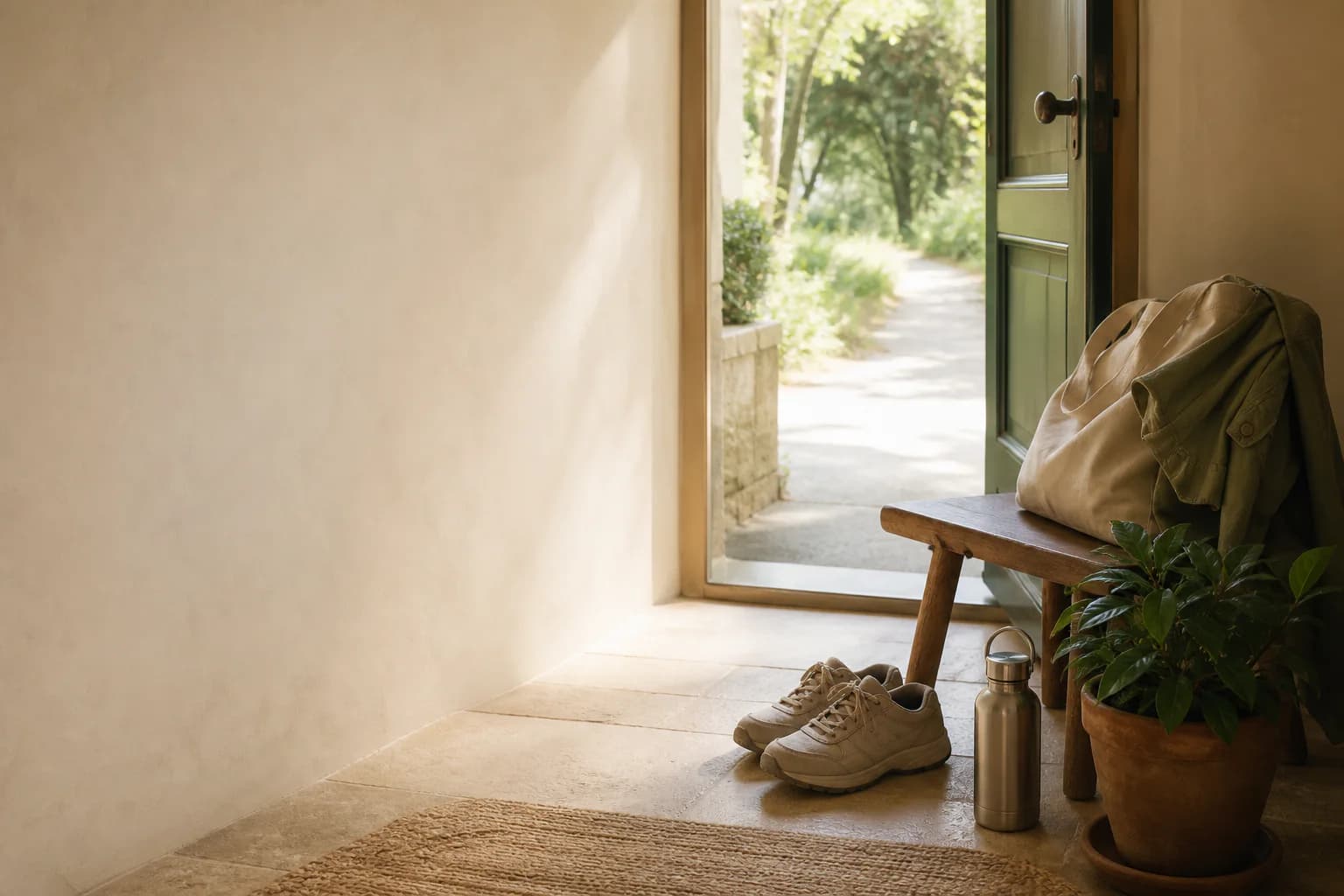
Working from home creates its own movement barriers. Maybe the shoes are in another room. Maybe you only remember to move once you are already deep into a deadline. Maybe the easiest route feels cluttered, the front door setup is annoying, or the break feels pointless because there is no clear task waiting when you come back. Those details matter more than motivation speeches.
A better setup removes one or two repeated frictions. Keep shoes or a light layer easy to grab if you use them. Leave one obvious next task before you step away. Make the route boring and familiar. If the return to work feels clean, the movement break stops feeling like a detour.
- Keep anything you truly need for the route easy to reach.
- Leave yourself one obvious restart task before stepping away.
- Use the route that feels least complicated, not the one that sounds most impressive.
Make the return to work simple
The habit gets easier when you know exactly what happens after the walk: sit down, reopen one task, and spend one minute restarting instead of drifting into random tabs.
Choose a normal version and a deadline-day fallback
A work-from-home movement routine lasts longer when it has two sizes. The normal version might be a short morning loop, a lunch walk, and one standing call. The fallback version might be standing for one meeting, walking for three minutes after lunch, or pacing while you wait for coffee. Without that smaller option, the busiest days erase the habit completely.
The fallback is not a consolation prize. It is what keeps the routine alive during a real week. Remote work can be flexible, but it can also become very compressed. A smaller version lets you keep the cue even when the longer route does not fit.
- Write down one normal version and one smaller fallback.
- Use the same cues even when the movement window gets shorter.
- Let the fallback count on purpose instead of treating it like failure.
A realistic fallback split
The smaller version should feel almost too easy on a crowded day.
- One call taken standing.
- One two- or three-minute loop after lunch.
- One short walk right after closing the laptop.
Try a five-workday reset before making the routine bigger
You do not need a full home-fitness system to test whether this works. A five-workday reset is enough. Choose one morning or lunch cue, one route, and one fallback. Repeat them long enough to see whether the real friction is timing, route setup, task matching, or simply trying to do too much on day one.
That short reset gives you better information than a broad promise to stop sitting so much. If the routine helps the day feel a little less static without making work more fragmented, keep it. If it keeps failing, shrink the route, move the cue, or rely more on standing and call-based movement first.
A simple five-day checklist
Keep the test small enough that it fits beside work rather than competing with it.
- Day 1: choose one cue, one route, and one fallback version.
- Day 2: repeat the same movement window without changing anything.
- Day 3: fix one friction point around shoes, route, or return to work.
- Day 4: use the fallback version on purpose.
- Day 5: review what felt easiest to repeat on a normal home workday.
Common mistakes that make home workdays more sedentary than they need to be
One common mistake is saving movement for a perfect workout block that never quite appears between calls and home tasks. Another is trying to walk or stand during the wrong kind of work, then deciding the whole idea is distracting. A third is skipping the route decision and relying on memory to interrupt a screen-heavy day.
Another trap is treating short movement windows as meaningless. CDC and NIOSH guidance both support the basic idea that moving more, sitting less, and changing posture through the day is worthwhile. The better routine is smaller and calmer: one clear cue, one route you trust, one fallback for deadline days, and one reminder that a short break can still do useful work. If your home workday includes a little more movement and a little less sitting than it used to, the system is already helping.
- Do not wait for a large empty block before you let movement count.
- Do not force your hardest screen tasks into walking or standing if they work worse that way.
- Do not make the route decision every single time.
- Do not treat the busy-day fallback like failure.